Pressure Washing Prices in Austin (2026)
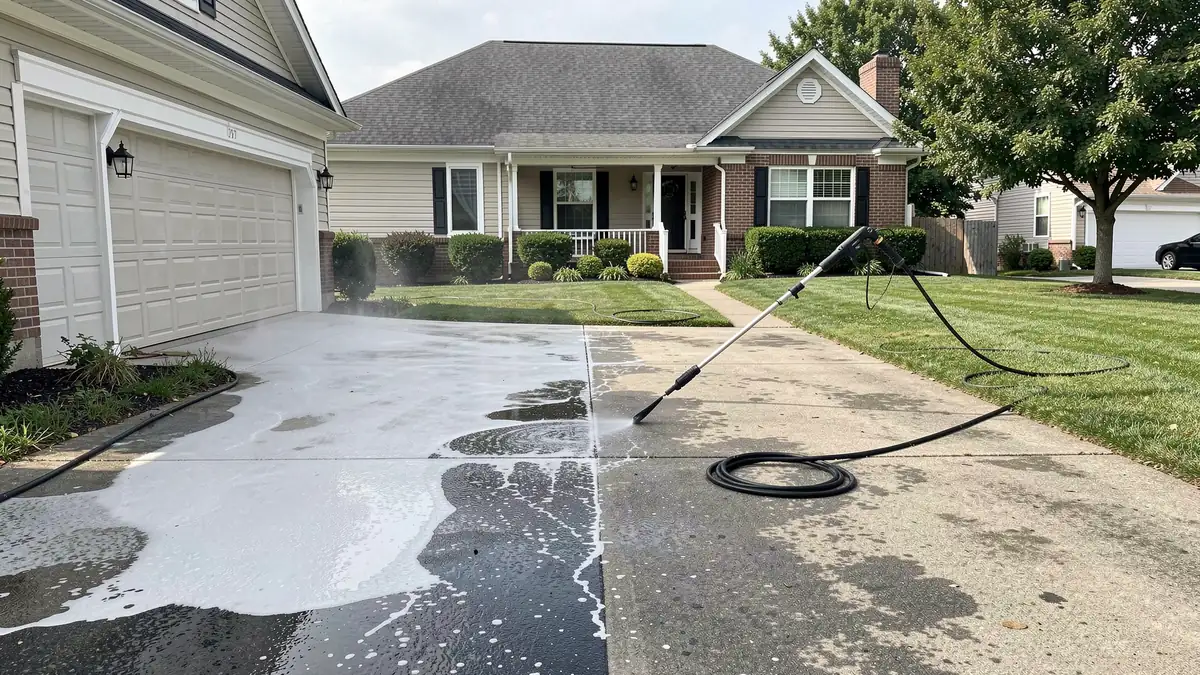
Austin pressure washing prices typically run above national benchmarks — the metro sits in the high cost band. A 600–1,000 sq ft driveway most often quotes $140–$310, a full house soft wash runs roughly $290–$700, and wood decks land near $175–$410. The market earns its character from three Texas specifics: a winter cedar-pollen season that coats every surface in tan film, Hill Country limestone and soft stone that punish careless pressure, and a drought-cycle water culture that has crews checking Austin Water's current stage before they schedule.
By the MowMath editorial team · Updated $1
Key numbers at a glance
| Job | Typical Austin range (2026) | Notes |
|---|---|---|
| Driveway (600–1,000 sq ft) | $140–$310 | Cedar film and heat-baked stains; cracked slabs need lower pressure |
| House wash (1,500–2,500 sq ft siding) | $290–$700 | Soft wash; pollen film and shaded-wall mildew are common |
| Driveway + house bundle | $400–$875 | Best per-hour value; same stop, same setup |
| Wood deck (200–400 sq ft) | $175–$410 | Lower PSI; sun and heat check the wood |
Pressure washing prices in Austin: the ranges
The national benchmarks this site uses are $120–$260 for a driveway, $250–$600 for a house wash and $150–$350 for a deck. Austin sits in the high cost band, so those figures shift up — typically by roughly 15–20 percent — and condition decides where inside each band a quote lands. A new vinyl-sided home in Pflugerville with light dust washes fast; the same house after cedar season carries a pollen film that needs pretreatment, and a limestone patio or cracked clay-soil slab wants lower pressure and more care time. Every number below is a hedged range for planning, not a surveyed price.
| Job | Typical Austin range (2026) | Notes |
|---|---|---|
| Driveway (600–1,000 sq ft) | $140–$310 | Cedar film and heat-baked stains; cracked slabs need lower pressure |
| House wash (1,500–2,500 sq ft siding) | $290–$700 | Soft wash; pollen film and shaded-wall mildew are common |
| Driveway + house bundle | $400–$875 | Best per-hour value; same stop, same setup |
| Wood deck (200–400 sq ft) | $175–$410 | Lower PSI; sun and heat check the wood |
| Patio / pavers + poly sand | $230–$525 | Limestone patios need soft wash, not blast |
| Fence (linear ft) | $1.75–$4.00 / ft | Both sides priced separately |
Inside the metro, the pattern runs by age and geology. Central neighborhoods — Hyde Park, Travis Heights, Zilker-adjacent streets — carry mature oaks, shaded fences and older concrete that quote mid-to-high in the band. The northern suburbs — Round Rock, Cedar Park, Pflugerville, Hutto — are dominated by newer brick and vinyl with wide driveways that wash clean and fast, often through HOA accounts. West and southwest — West Lake Hills, Dripping Springs, down toward Buda and Kyle — the Hill Country limestone, flagstone and heavy masonry take over, and soft stone is where careless high pressure does four-figure damage in minutes. Access, shade and surface, more than geography, decide the number.
What moves prices in Austin
Climate, cedar and mildew. Austin is humid subtropical with long, brutally hot summers. Winter brings the region's signature event: mountain cedar (ashe juniper) releases pollen roughly December into February, and the film it leaves on siding, glass, fences and driveways triggers a real wave of wash calls once it settles. Spring adds oak pollen on top. During humid stretches, mildew and algae colonize shaded north walls and fence lines, though nothing like Houston's pace. Summer heat bakes stains into concrete and pushes crews to dawn starts. Most homes here benefit from a wash roughly every one to two years, with post-cedar-season washes the most common trigger.
Stone, housing age and clay soil. The metro is one of the fastest-growing in the country, and the suburban stock skews new — brick and vinyl that soft wash quickly. The central core is older, with mature shade that feeds mildew and mix-era concrete that wants care. The real Austin complication is stone: limestone, Austin stone accents and flagstone patios are everywhere west and southwest, and soft sedimentary stone etches under high pressure, so competent crews drop to low pressure and let chemistry do the work — that is skilled, slower labor and it prices accordingly. Underneath it all sits the same Central Texas expansive clay as Dallas: slabs shift, crack and offset, and blasting cracked joints widens fault lines and blows out joint sand. Careful operators drop PSI on damaged sections and quote sealing as a surface-preserving upsell.
Heat, seasonality and demand. Working hours compress in summer — surface temperatures can make midday concrete work both unpleasant and streak-prone — so the practical season front-loads into spring and stretches through a warm October. The busiest windows are the post-cedar flush in late winter and the post-pollen spring wave, when good crews book out and quotes firm up toward the high end of every band. Schedule three to four weeks ahead in those windows; in the slower deep-summer and mid-winter weeks, quotes drift toward the low end.
Local cost drivers and water rules. Labor, fuel and insurance costs run above national averages in this market — that is the high-band premium you see in every row of the table. On water: Austin Water runs staged drought-contingency rules that mainly restrict irrigation days and hours during dry cycles, and a wash uses a small fraction of what irrigation does, but the stages can shift quickly with Highland Lakes storage — verify the current stage with Austin Water before scheduling recurring work. As everywhere, wash water belongs out of storm drains; crews working curb-line driveways should carry drain protection, and the city's creek-sensitive layout makes that a real expectation here.
Questions worth asking any Austin provider:
- How do you handle limestone and soft stone? Low pressure plus chemistry — never a direct high-pressure blast on Austin stone.
- What takes the cedar film off — water or chemistry? Pollen film needs a pretreat and rinse; water alone leaves the haze.
- How do you treat cracked slab concrete? Dropped pressure on cracked areas and a sealer conversation, not full blast across joints.
- Can you bundle driveway, house and fence? Bundles are the best per-hour value in every market, including this one.
Stack these bands against the other 24 metros on the pressure washing prices by city hub, turn any surface into a defensible number with the pressure washing calculator, and compare the other half of the property budget on the lawn care prices in Austin page. The local band sets the market; the math keeps you honest inside it.
FAQ
How much does pressure washing cost in Austin?
Austin sits in the high cost band, so expect roughly 15–20 percent above national benchmarks: typically $140–$310 for a 600–1,000 sq ft driveway, $290–$700 for a full house soft wash, and $175–$410 for a wood deck. Cedar-pollen film, limestone surfaces and cracked clay-soil slabs push quotes toward the top of the band.
How much does it cost to pressure wash a driveway in Austin?
Typically $140–$310 for 600–1,000 sq ft of concrete. Central Texas clay shifts slabs, so settling cracks and offset joints are common — careful crews drop pressure on cracked areas, and the extra care time nudges those jobs toward the high end.
How much does a house wash cost in Austin?
Roughly $290–$700 for 1,500–2,500 sq ft of siding, soft wash with chemicals included. Winter cedar pollen coats every elevation in a tan film, and mildew finds shaded north walls during humid stretches.
Why is pressure washing more expensive in Austin than the national average?
Austin is a high cost-band metro: labor, fuel and insurance run above national averages, summer heat compresses workable hours into early mornings, and the Hill Country's limestone and soft stone demand low-pressure soft washing rather than fast blast work. All of that shows up in the quote.
Do Austin water restrictions affect pressure washing?
Rarely directly. Austin Water runs staged drought-contingency rules that mainly restrict irrigation days and hours, and a wash uses a small fraction of that volume. Verify the current stage with Austin Water before scheduling recurring work.