Pressure Washing Prices in Boston (2026)
Boston pressure washing prices typically run 30–40 percent above national benchmarks: a 600–1,000 sq ft driveway most often quotes $155–$365, a full house soft wash runs roughly $325–$840, and wood decks land near $195–$490. The market pairs some of the highest labor and overhead costs in the country with a housing stock old enough to demand care — triple-deckers, pre-war clapboard and lead-era paint — and a New England winter that salts every slab white by March, then compresses the whole cleaning year into roughly seven months.
By the MowMath editorial team · Updated $1
Key numbers at a glance
| Job | Typical Boston range (2026) | Notes |
|---|---|---|
| Driveway (600–1,000 sq ft) | $155–$365 | Road-salt residue and efflorescence after winter |
| House wash (1,500–2,500 sq ft siding) | $325–$840 | Soft wash; algae on shaded walls, lead-safe care on old paint |
| Driveway + house bundle | $455–$1,050 | Best per-hour value; same stop, same setup |
| Wood deck (200–400 sq ft) | $195–$490 | Lower PSI; older framing checks and splits |
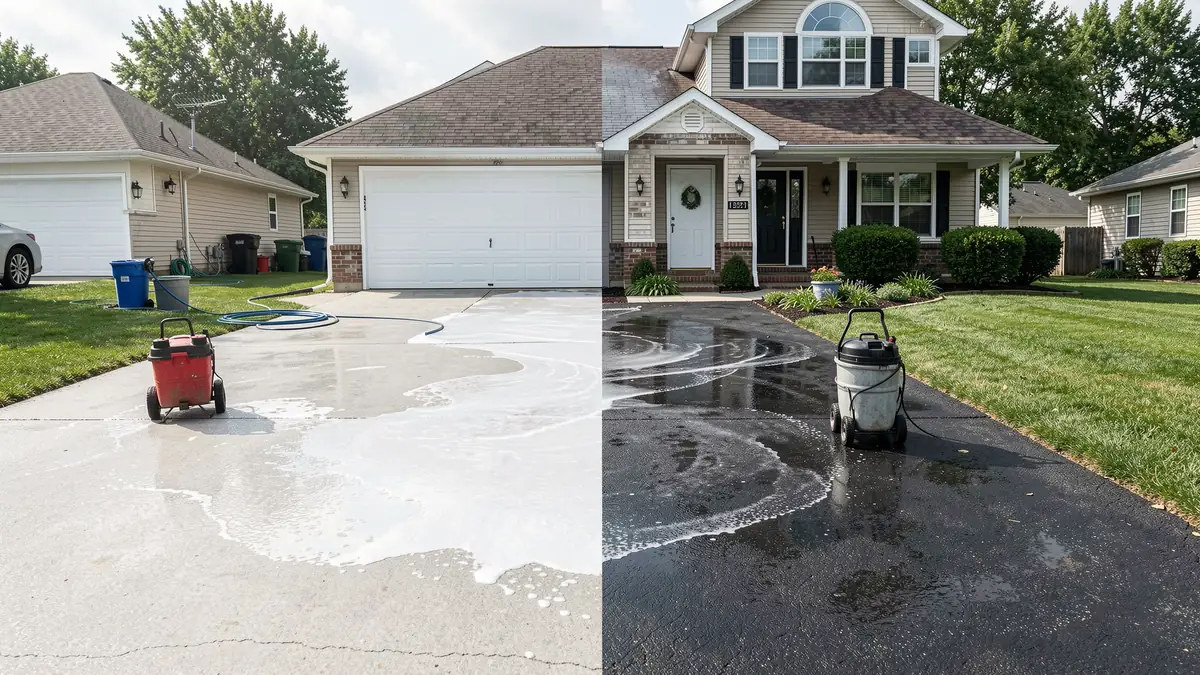
Pressure washing prices in Boston: the ranges
The national benchmarks this site uses are $120–$260 for a driveway, $250–$600 for a house wash and $150–$350 for a deck. Boston sits in the very high cost band, so those figures typically shift up 30–40 percent. Condition moves the number as much as size here: a driveway that spent five months under road salt and snowmelt needs pretreatment and a slower pass plan than the same slab in Philadelphia, and concrete that has scaled from freeze-thaw cycles requires lower pressure and more chemistry. Every number below is a hedged range for planning, not a surveyed price.
| Job | Typical Boston range (2026) | Notes |
|---|---|---|
| Driveway (600–1,000 sq ft) | $155–$365 | Road-salt residue and efflorescence after winter |
| House wash (1,500–2,500 sq ft siding) | $325–$840 | Soft wash; algae on shaded walls, lead-safe care on old paint |
| Driveway + house bundle | $455–$1,050 | Best per-hour value; same stop, same setup |
| Wood deck (200–400 sq ft) | $195–$490 | Lower PSI; older framing checks and splits |
| Patio / pavers + poly sand | $260–$630 | Poly sanding sells well after a hard winter |
| Fence (linear ft) | $2.00–$4.90 / ft | Both sides priced separately |
Inside the metro, the dense core — South Boston, Dorchester, Charlestown — runs triple-deckers and rowhouses with small footprints, tight alley access and porch work that price mid-to-high on care rather than square footage. Inner suburbs — Cambridge, Somerville, Brookline — carry the same era of housing with stronger route density. The Route 128 belt — Newton, Needham, Wellesley — runs bigger driveways and two-story washes at the top of every band, and the I-495 exurbs quote mid-band with long paver driveways and newer fiber-cement that washes fast. Downtown condos and storefronts buy mostly sidewalk and facade work under building-management rules.
What moves prices in Boston
Climate, salt and mildew. Boston runs two grime seasons. Winter lays down road salt that leaves white residue and staining on stoops, sidewalks, garage aprons and porch steps — salt removal anchors the spring rush, and it sells because salt also accelerates the spalling that ruins concrete. Summer brings humid air that grows algae and mildew on north-facing walls, shaded fences and porch ceilings. A property here typically benefits from a wash every one to two years, with salted walk areas needing annual spring attention.
Housing age, siding and lead paint. Boston's core housing is pre-war — triple-deckers with wood or asphalt-sided bays, shingle-style homes, brick rowhouses with soft mortar — and much of its painted woodwork predates the 1978 federal lead-paint cutoff. Professional work that disturbs paint on pre-1978 surfaces falls under the EPA's Renovation, Repair and Painting rule (epa.gov/lead), which sets lead-safe practices. The practical translation: soft wash, not blast; chemistry, not force. High pressure on old clapboard strips paint, fuzzes wood and turns a wash into a repaint with a compliance problem attached. A test patch on old siding is a 30-second insurance policy.
Storm cycles and a compressed season. Nor'easters track grime, tannin and salt spray onto siding and gutters, and the washing calendar runs roughly April through October — freeze-thaw makes winter concrete work risky and ice makes it dangerous. That compression pushes rates the way it does for ski-country trades: a Boston washing business earns its year in about seven months, and many of the same operators sell snow removal all winter, which is why two-season customers usually negotiate the better rate on both. Book spring salt-removal work by late winter; everyone in the metro wants the same first dry month.
Labor, overhead and water rules. The 30–40 percent premium over national benchmarks is mostly overhead — big-metro wages, commercial insurance, fuel, and traffic between suburb clusters that burns unpaid hours. On the water side, the Boston Water and Sewer Commission treats non-stormwater flow into storm drains as illicit discharge — most catch basins connect straight to local waterways untreated, and enforcement can reach thousands of dollars per day, per violation, under the Commission's programs. Wash water belongs captured or diverted to a sanitary connection, not rinsed toward the nearest grate.
Questions worth asking any Boston provider:
- What is included in spring salt removal? Pretreatment and rinse, not just a pass — get the chemistry named on the quote.
- How do you handle pre-1978 paint? Lead-safe practices under the RRP rule are the professional answer on old triple-deckers.
- Do you sell washing and snow together? Two-season customers usually get the better rate on both.
- How do you handle scaled concrete? Lower pressure and a sealer conversation — not full blast on a flaking slab.
Stack these bands against the other 24 metros on the pressure washing prices by city hub, turn any surface into a defensible number with the pressure washing calculator, and compare the other half of the property budget on the lawn care prices in Boston page. The local band sets the market; the math keeps you honest inside it.
FAQ
How much does pressure washing cost in Boston?
Boston typically runs 30–40 percent above national benchmarks: roughly $155–$365 for a 600–1,000 sq ft driveway, $325–$840 for a full house soft wash, and $195–$490 for a wood deck. Big-metro labor, pre-war housing and a compressed season set the floor.
How much does it cost to pressure wash a driveway in Boston?
Typically $155–$365 for 600–1,000 sq ft of concrete. Road-salt residue and efflorescence after a New England winter need pretreatment to lift, and freeze-thaw scaling demands lower pressure — both push quotes toward the top of the band in spring.
How much does a house wash cost in Boston?
Roughly $325–$840 for 1,500–2,500 sq ft of siding, soft wash with chemicals included. Humid summers grow algae on shaded walls, triple-decker and pre-war clapboard needs gentle chemistry, and any pre-1978 paint calls for lead-safe practices under the EPA RRP rule.
When is pressure washing season in Boston?
Roughly April through October. Nor'easters and freeze-thaw make winter work risky for concrete and unsafe for crews, so demand compresses into a warm-weather window — book spring salt-removal work early, because everyone in the metro wants the same first dry month.
Can wash water go down Boston storm drains?
No. The Boston Water and Sewer Commission treats non-stormwater flow into storm drains as an illicit discharge — most catch basins connect straight to local waterways untreated — and enforcement can run to thousands of dollars per day. Professional crews capture wash water or divert it to sanitary connections; report and verify expectations via bwsc.org.