Pressure Washing Prices in Denver (2026)
Denver pressure washing prices typically run 15–25 percent above national benchmarks: a 600–1,000 sq ft driveway most often quotes $140–$325, a full house soft wash runs roughly $290–$750, and wood decks land near $175–$440. The market pairs Front Range labor costs with a climate that punishes every surface twice — winter lays down de-icer and freeze-thaw on concrete while altitude sun bakes grime into it, and spring hail seasons hand the whole metro a roof-replacement dust problem. In 2026 there is a third factor no other big metro matches: Denver Water's drought rules put power washing itself under restriction.
By the MowMath editorial team · Updated $1
Key numbers at a glance
| Job | Typical Denver range (2026) | Notes |
|---|---|---|
| Driveway (600–1,000 sq ft) | $140–$325 | De-icer residue and freeze-thaw scaling after winter |
| House wash (1,500–2,500 sq ft siding) | $290–$750 | Soft wash; sun grime plus post-hail roof dust |
| Driveway + house bundle | $400–$940 | Best per-hour value; same stop, same setup |
| Wood deck (200–400 sq ft) | $175–$440 | Lower PSI; altitude sun checks and grays the wood |
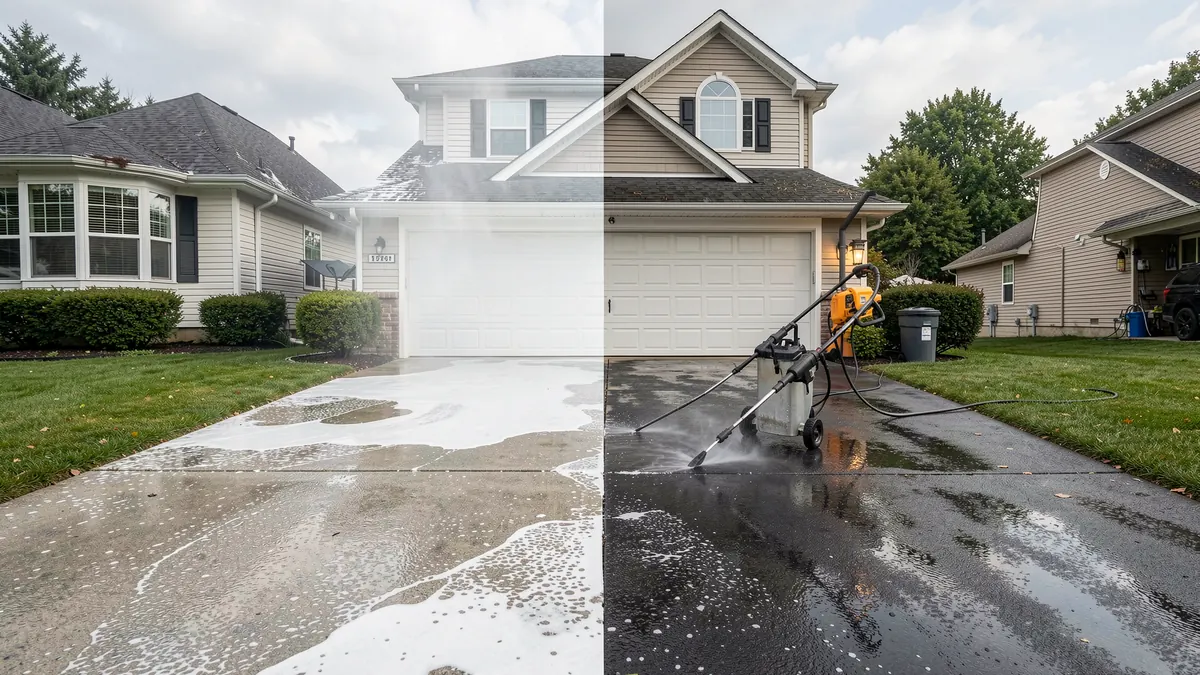
Pressure washing prices in Denver: the ranges
The national benchmarks this site uses are $120–$260 for a driveway, $250–$600 for a house wash and $150–$350 for a deck. Denver sits in the high cost band, so those figures typically shift up 15–25 percent. Concrete condition moves the number as much as size here: a slab that spent five months under de-icer and freeze-thaw cycles needs pretreatment and lower pressure than the same driveway in a mild city, and sun at a mile of elevation bakes oil and grime into surfaces in a way lower-altitude markets rarely see. Every number below is a hedged range for planning, not a surveyed price.
| Job | Typical Denver range (2026) | Notes |
|---|---|---|
| Driveway (600–1,000 sq ft) | $140–$325 | De-icer residue and freeze-thaw scaling after winter |
| House wash (1,500–2,500 sq ft siding) | $290–$750 | Soft wash; sun grime plus post-hail roof dust |
| Driveway + house bundle | $400–$940 | Best per-hour value; same stop, same setup |
| Wood deck (200–400 sq ft) | $175–$440 | Lower PSI; altitude sun checks and grays the wood |
| Patio / pavers + poly sand | $230–$560 | Poly sanding sells well after a hard winter |
| Fence (linear ft) | $1.75–$4.40 / ft | Both sides priced separately |
Inside the metro, central Denver — Capitol Hill, Wash Park, the older streetcar districts — carries century-old housing, small footprints and alley access that price near the minimum on dense routes. The southern and southeastern suburbs — Centennial, Highlands Ranch, Parker — run bigger paver driveways and newer two-story washes through the middle-to-high end of every band. The northern stretch — Westminster, Broomfield, Thornton — mixes new-build vinyl and fiber-cement that wash fast, and the foothill communities west of town add slope, wind exposure and sun-weathered cedar to the ticket. Downtown condos and storefronts buy mostly sidewalk and facade work under building-management rules.
What moves prices in Denver
Climate, de-icer and altitude sun. Denver runs two grime seasons. Winter lays down magnesium-chloride de-icer and road salt that leave white residue and staining on driveways, walks and garage aprons — spring removal is the anchor of the post-winter rush, and it sells because de-icer also accelerates the freeze-thaw scaling that ruins concrete. The other season never ends: sun at altitude, roughly 300 days of it a year by local convention, bakes oil into driveways and grays wood decks and fences faster than sea-level cities see. A property here typically benefits from a wash every one to two years, with salted walk areas needing annual spring attention.
Housing age and concrete condition. The core neighborhoods hold early-1900s brick bungalows with soft mortar that wants soft wash, never a blast, while a large share of the metro's housing is late twentieth century — vinyl, fiber-cement and stucco over clay soil that shifts and cracks slabs. Cracked and offset driveway joints are common enough to be a Denver quote item: competent crews drop pressure on cracked areas and let pretreat chemistry do the lifting, which is exactly why their quotes outprice a rental machine. Wood decking grays fast in the altitude sun; lower PSI and a brightener conversation follow. A test patch on old mortar or weathered wood is a 30-second insurance policy.
Hail cycles and a compressed season. Spring and summer hail drives roof replacements across whole neighborhoods, and every reroof leaves dust, debris and streaking on siding and driveways — post-roof washes cluster into waves of demand that book good crews out for weeks. The washing calendar itself runs roughly March through October, because freeze-thaw makes winter concrete work risky and ice makes it dangerous. That compression pushes rates the way it does for ski-town trades: a Denver washing business earns its year in about eight months, and many of the same operators sell snow removal all winter, which is why two-season customers usually negotiate the better rate on both.
Water rules — the Denver difference. Denver Water's outdoor water-use rules are stricter than most Western utilities: power washing of fences and other hard surfaces is allowed only when necessary for immediate health or safety, and the utility declared a Stage 1 drought in 2026 that tightened outdoor water use further. Health-and-safety cleaning — de-icer residue, sanitation, pre-paint prep — remains the legitimate category. Verify the current stage and exact rules with Denver Water before scheduling, and favor crews who use water-efficient surface cleaners and capture wash water away from storm drains, which drain toward the South Platte.
Questions worth asking any Denver provider:
- What is included in spring de-icer removal? Pretreatment and rinse, not just a pass — get the chemistry named on the quote.
- How do you handle cracked or scaled concrete? Lower pressure on damaged areas, not full blast on a flaking slab.
- How do you follow Denver Water's drought rules? Surface cleaners, shutoff equipment and health-and-safety framing are the professional answers.
- Do you sell washing and snow together? Two-season customers usually get the better rate on both.
Stack these bands against the other 24 metros on the pressure washing prices by city hub, turn any surface into a defensible number with the pressure washing calculator, and compare the other half of the property budget on the lawn care prices in Denver page. The local band sets the market; the math keeps you honest inside it.
FAQ
How much does pressure washing cost in Denver?
Denver typically runs 15–25 percent above national benchmarks: roughly $140–$325 for a 600–1,000 sq ft driveway, $290–$750 for a full house soft wash, and $175–$440 for a wood deck. Front Range labor, hail cycles and altitude sun set the floor.
How much does it cost to pressure wash a driveway in Denver?
Typically $140–$325 for 600–1,000 sq ft of concrete. De-icer residue and freeze-thaw scaling after a hard winter add pretreatment and care time, and sun-baked oil stains at altitude need chemistry to lift, pushing stained slabs toward the top of the band.
How much does a house wash cost in Denver?
Roughly $290–$750 for 1,500–2,500 sq ft of siding, soft wash with chemicals included. Strong sun grime and dust film coat south- and west-facing walls, thunderstorm seasons track mud and tannin onto lower elevations, and hail repairs leave post-roof dust that needs a full rinse.
When is pressure washing season in Denver?
Roughly March through October. Freeze-thaw makes winter concrete work risky and ice makes it dangerous, so demand compresses into a long but defined season — book spring de-icer removal and post-hail washes early, because good crews run full schedules by June.
Do Denver Water rules restrict pressure washing?
Yes — more than in most cities. Denver Water's outdoor water rules limit power washing of hard surfaces to cases necessary for immediate health or safety, and a Stage 1 drought declared in 2026 tightened outdoor use further. Verify the current stage and rules at denverwater.org before scheduling or quoting work.