Pressure Washing Prices in Tampa (2026)
Tampa pressure washing prices typically track national benchmarks — the metro sits in the average cost band. A 600–1,000 sq ft driveway most often quotes $120–$260, a full house soft wash runs roughly $250–$600, and wood decks land near $150–$350. What gives the market its character is water in every form: bay humidity that grows mildew and algae faster than most of the country, salt air that films homes near the water, and a hurricane season that swings demand from quiet to booked-out in a single storm week.
By the MowMath editorial team · Updated $1
Key numbers at a glance
| Job | Typical Tampa range (2026) | Notes |
|---|---|---|
| Driveway (600–1,000 sq ft) | $120–$260 | Heavy algae film; salt staining near the water |
| House wash (1,500–2,500 sq ft siding) | $250–$600 | Soft wash; shaded elevations grow mildew fast |
| Driveway + house bundle | $350–$750 | Best per-hour value; same stop, same setup |
| Wood deck (200–400 sq ft) | $150–$350 | Lower PSI; humidity feeds surface growth |
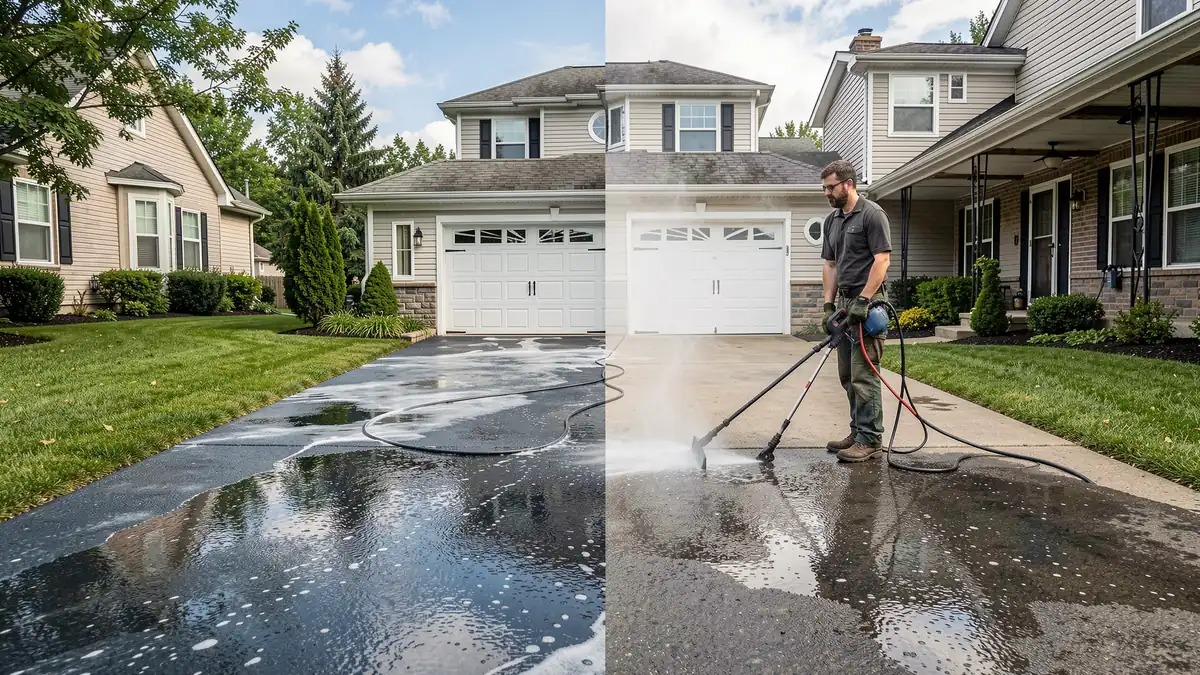
Pressure washing prices in Tampa: the ranges
The national benchmarks this site uses are $120–$260 for a driveway, $250–$600 for a house wash and $150–$350 for a deck, and Tampa sits in the average cost band — so those figures hold, with condition and proximity to water deciding where inside each range a quote lands. A stucco home in Brandon with light dust washes fast; the same house in South Tampa under mature oaks carries algae streaks on shaded elevations that need treatment, and a paver pool deck usually adds re-sanding on top of the wash. Every number below is a hedged range for planning, not a surveyed price.
| Job | Typical Tampa range (2026) | Notes |
|---|---|---|
| Driveway (600–1,000 sq ft) | $120–$260 | Heavy algae film; salt staining near the water |
| House wash (1,500–2,500 sq ft siding) | $250–$600 | Soft wash; shaded elevations grow mildew fast |
| Driveway + house bundle | $350–$750 | Best per-hour value; same stop, same setup |
| Wood deck (200–400 sq ft) | $150–$350 | Lower PSI; humidity feeds surface growth |
| Patio / pavers + poly sand | $200–$450 | Pool decks are steady work; dockside work extra |
| Fence (linear ft) | $1.50–$3.50 / ft | Both sides priced separately |
Inside the metro, the pattern runs by era and distance from the water. South Tampa and St. Petersburg carry 1950s–70s block ranches under mature canopies — shade feeds growth, and older concrete and painted surfaces want care, so those jobs quote mid-to-high. The fast-growing rings — Wesley Chapel, Lithia, Land O' Lakes, Riverview — are dominated by newer stucco with wide driveways and screened pool enclosures that wash efficiently, often through HOA accounts. Along the bay and down the gulf beaches, salt film and shorter wash cycles push the same jobs into the upper half of the band. Access, shade and surface, more than geography, decide the number.
What moves prices in Tampa
Climate, mildew and algae. Tampa is humid subtropical with a rainy season roughly June into September and afternoon storms that keep everything damp. The signature job here is green: mildew and algae colonize driveways, sidewalks, siding and fences quickly, especially on shaded and north-facing surfaces. Soft-wash chemistry matters more than raw pressure in this climate — treatment kills the growth rather than rinsing the top layer, which slows regrowth and justifies the quote. Most homes here benefit from a wash roughly once a year; shaded and canal-side properties often do better on a twice-yearly cycle (hedged — ask your provider what your exposure calls for).
Salt air, housing age and pavers. The stock mixes mid-century block ranches near the core with post-2000 stucco in the suburbs. Block and stucco take soft washing well; older painted surfaces and soft trim want low pressure. Nearer the bay and gulf, salt air leaves a film on siding, glass and concrete and accelerates grime, so coastal homes typically wash on shorter cycles — that is real recurring revenue for crews and a real line item for owners. Paver pool decks are a Tampa staple and usually want joint sand refreshed after washing, which adds ticket value. Sandy soil shifts with the water table, so cracked and settled slab corners are common enough that careful crews drop pressure on damaged sections rather than blast them.
Storms, seasonality and demand. Hurricane season (roughly June through November) swings this market hard. Ahead of storms, homeowners want clean surfaces and clear drainage; after a named storm, crews chase leaves, staining, sediment and debris for weeks, and good operators book out while quotes sit at the top of every band. The steadier baseline is the maintenance cycle — a spring refresh ahead of the humid season and a fall cleanup — plus snowbird-season turnover washes ahead of winter, when owners want properties pristine for arriving residents and guests. Schedule routine work in the shoulder months, not the week after a storm.
Local cost drivers and water rules. Labor and operating costs run near national averages, which is why the benchmarks hold. On water: the Tampa Bay region operates under watering-day rules set by the Southwest Florida Water Management District — the rules mainly govern irrigation, and a wash uses a small fraction of that volume, but restrictions can tighten during drought, so verify current rules with the Southwest Florida Water Management District or your local utility before scheduling recurring work. As everywhere, wash water belongs out of storm drains — in a metro where runoff feeds the bay directly, that expectation shapes how reputable crews set up on curb-line driveways.
Questions worth asking any Tampa provider:
- Do you treat the mildew or just rinse it? Soft-wash chemistry kills growth and slows regrowth; water alone postpones it.
- How do you handle salt film near the water? A low-pressure soft wash with the right rinse, not a blast that drives salt into pores.
- Is paver re-sanding included? Washing pool pavers without refreshing joint sand is half the job.
- Can you bundle driveway, house and deck? Bundles are the best per-hour value in every market, including this one.
Stack these bands against the other 24 metros on the pressure washing prices by city hub, turn any surface into a defensible number with the pressure washing calculator, and compare the other half of the property budget on the lawn care prices in Tampa page. The local band sets the market; the math keeps you honest inside it.
FAQ
How much does pressure washing cost in Tampa?
Tampa typically tracks national benchmarks: roughly $120–$260 for a 600–1,000 sq ft driveway, $250–$600 for a full house soft wash, and $150–$350 for a wood deck. Heavy mildew growth, salt-air film near the bay and pool-deck add-ons move quotes toward the top of the band.
How much does it cost to pressure wash a driveway in Tampa?
Typically $120–$260 for 600–1,000 sq ft of concrete. Bay-area humidity grows a green algae film on shaded and north-facing concrete quickly, so surface pretreatment is standard and slows regrowth compared with a rinse-only wash.
How much does a house wash cost in Tampa?
Roughly $250–$600 for 1,500–2,500 sq ft of siding, soft wash with chemicals included. Mildew and algae colonize shaded elevations fast in the humid climate, and homes nearer the water pick up salt film that needs a proper soft-wash rinse.
Does living near Tampa Bay or the gulf beaches change the price?
It can. Salt air leaves a film on siding and concrete close to the water and feeds faster surface growth, and coastal homes often wash on a shorter cycle — commonly about twice a year rather than once. Expect quotes in the upper half of the band for coastal work.
Do Tampa water restrictions affect pressure washing?
Rarely directly. The Southwest Florida Water Management District sets watering-day rules that mainly govern irrigation, and a wash uses a small fraction of that volume. Verify current rules with the district or your utility before scheduling recurring work.