Pressure Washing Prices in Washington DC (2026)
Washington DC pressure washing prices typically run 30–40 percent above national benchmarks: a 600–1,000 sq ft driveway most often quotes $155–$365, a full house soft wash runs roughly $325–$840, and wood decks land near $195–$490. The market pairs some of the highest labor and overhead costs in the country with a mid-Atlantic grime cycle that never quits — a spring that coats every surface in pollen, a summer humid enough to mildew every shaded wall, a winter of salt — plus a rowhouse housing stock where the brick itself demands a gentler, more careful wash than vinyl ever will.
By the MowMath editorial team · Updated $1
Key numbers at a glance
| Job | Typical Washington DC range (2026) | Notes |
|---|---|---|
| Driveway (600–1,000 sq ft) | $155–$365 | Salt residue and humidity staining; alley pads price near minimum |
| House wash (1,500–2,500 sq ft siding) | $325–$840 | Soft wash; rowhouse brick and old mortar need gentle chemistry |
| Driveway + house bundle | $455–$1,050 | Best per-hour value; same stop, same setup |
| Wood deck (200–400 sq ft) | $195–$490 | Lower PSI; humid summers mildew deck boards fast |
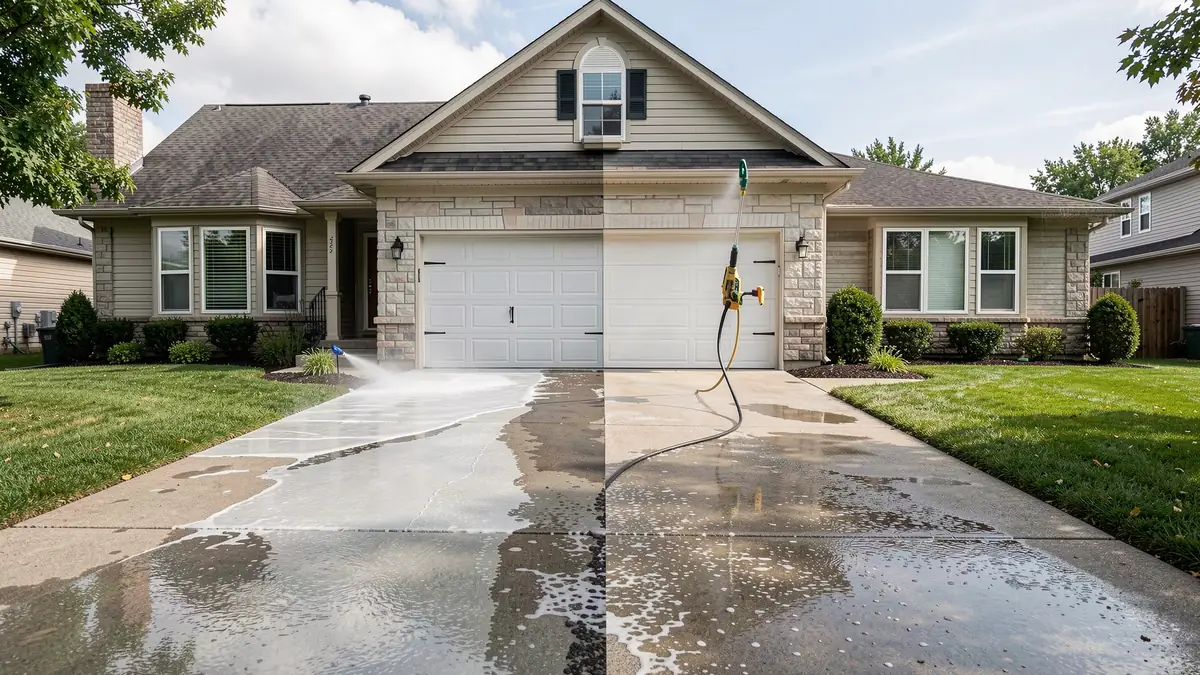
Pressure washing prices in Washington DC: the ranges
The national benchmarks this site uses are $120–$260 for a driveway, $250–$600 for a house wash and $150–$350 for a deck. Washington DC sits in the very high cost band, so those figures typically shift up 30–40 percent. Surface type moves the number as much as size here: rowhouse brick and century-old mortar want soft wash with longer chemical dwell, humid-summer mildew and pollen film add pretreatment to nearly every job, and much of the city trades long suburban driveways for alley pads, stoops and walkway fronts. Every number below is a hedged range for planning, not a surveyed price.
| Job | Typical Washington DC range (2026) | Notes |
|---|---|---|
| Driveway (600–1,000 sq ft) | $155–$365 | Salt residue and humidity staining; alley pads price near minimum |
| House wash (1,500–2,500 sq ft siding) | $325–$840 | Soft wash; rowhouse brick and old mortar need gentle chemistry |
| Driveway + house bundle | $455–$1,050 | Best per-hour value; same stop, same setup |
| Wood deck (200–400 sq ft) | $195–$490 | Lower PSI; humid summers mildew deck boards fast |
| Patio / pavers + poly sand | $260–$630 | Rowhouse patios and pocket yards are common adds |
| Fence (linear ft) | $2.00–$4.90 / ft | Both sides priced separately |
Inside the metro, the core — Capitol Hill, Dupont, Shaw, Columbia Heights — runs brick rowhouses where facades, stoops and front walks anchor the ticket and access is tight. Northwest neighborhoods like Cleveland Park and Chevy Chase DC mix rowhouses with larger detached homes that quote at the top of every band. Across the line, Montgomery County — Bethesda, Rockville, Potomac — and Northern Virginia — Arlington, Alexandria, McLean — carry bigger driveways, newer siding and two-story washes that run the middle-to-high band, and the close-in Virginia suburbs supply the densest route work. Downtown commercial and federal-adjacent buildings buy mostly sidewalk and facade cleaning under strict management rules.
What moves prices in Washington DC
Climate, pollen and mildew. DC runs three grime seasons, which is one more than most metros get. Spring drops a heavy yellow-green pollen film across every car, walkway, siding elevation and porch rail in the metro — the post-pollen wash is a ritual booking in May and June. Summer brings Chesapeake-humid air that grows algae and mildew on north-facing walls, shaded fences and deck boards. Winter lays down enough salt and brine to white-stain stoops, sidewalk strips and garage aprons by February. A property here typically benefits from a wash every one to two years, with shaded tree-lined lots on the annual end of that range.
Housing age, brick and mortar. The District's signature stock is the brick rowhouse — many dating to the late 1800s and early 1900s — alongside painted brick, old wood trim and soft mortar joints that have survived a century of weather. High pressure on old brick and mortar is how facades get etched and joints get destroyed; competent crews soft wash and let chemistry lift urban grime, exhaust film and mildew instead. Inside the Beltway, mid-century colonials and newer infill bring vinyl and fiber-cement that wash faster, which keeps suburban route work priced saner than the rowhouse core. A test patch on old mortar or painted brick is a 30-second insurance policy against a four-figure repointing bill.
Labor, access and route math. The 30–40 percent premium over national benchmarks is mostly overhead — among the highest wages, insurance and fuel costs in the country — plus the region's signature congestion: a route that crosses the Potomac burns unpaid bridge time twice. Parking a rig on a permit-blocked Capitol Hill street and hauling hose across sidewalks is its own cost line. What the metro gives back is density and wealth of work: a crew that books one rowhouse block can wash multiple fronts without moving the truck, and the Maryland and Virginia suburbs run conventional driveway-and-deck volume all season.
Water rules. DC treats wash water seriously because its drains feed the Anacostia and Potomac. District law prohibits allowing pollutants to enter the storm sewer system or waterways, enforced by the Department of Energy and Environment (doee.dc.gov) — and the rules differ by where you stand, because parts of the city drain to a combined sewer headed for treatment while separate storm-sewer areas discharge straight to the rivers. Professional crews capture or divert wash water rather than let it run to the nearest grate; verifying the block's drainage and current expectations is part of quoting work inside the city.
Questions worth asking any Washington DC provider:
- Soft wash or pressure on this brick? Old rowhouse brick and mortar should never see a close-range wand.
- What is your wash-water plan? Capture or diversion away from storm drains is the professional answer in DC.
- Can you handle the facade, stoop and front walk together? Bundled rowhouse frontage is where the ticket grows.
- When can you book the post-pollen wash? Late-spring slots fill fast — a crew with a calendar is a crew with work.
Stack these bands against the other 24 metros on the pressure washing prices by city hub, turn any surface into a defensible number with the pressure washing calculator, and compare the other half of the property budget on the lawn care prices in Washington DC page. The local band sets the market; the math keeps you honest inside it.

FAQ
How much does pressure washing cost in Washington DC?
Washington DC typically runs 30–40 percent above national benchmarks: roughly $155–$365 for a 600–1,000 sq ft driveway, $325–$840 for a full house soft wash, and $195–$490 for a wood deck. Federal-metro labor and old brick surfaces set the floor.
How much does a house wash cost in Washington DC?
Roughly $325–$840 for 1,500–2,500 sq ft of exterior, soft wash with chemicals included. Rowhouse brick and old mortar want low pressure and gentle chemistry, humid summers grow mildew on shaded walls, and spring coats every elevation in yellow-green pollen film.
How much does it cost to pressure wash a driveway in Washington DC?
Typically $155–$365 for 600–1,000 sq ft of concrete. Winter salt residue and summer humidity staining both add pretreatment time, and rowhouse neighborhoods often trade long driveways for alley pads and walkway work priced near the job minimum.
Can wash water go down DC storm drains?
No. DC law prohibits allowing pollutants into the storm sewer system or waterways — the Department of Energy and Environment enforces it, and whether a block drains to the combined sewer or a separate storm system changes the rules. Wash water should be captured or diverted; verify expectations via doee.dc.gov.
How often should a house be washed in Washington DC?
Most homes every one to two years, with shaded and tree-lined lots on the annual end. Spring pollen film and humid-summer mildew on north-facing walls make the post-pollen late-spring window the most popular booking slot in the metro.