What Is Minimum charge? (2026)
A minimum charge is the smallest number that gets the truck out of the driveway — roughly $30–$50 for mowing and $100–$150 for pressure washing. It exists because every stop costs real money before the first blade turns, and it is the single fastest margin fix in a service business.
By the MowMath editorial team · Updated $1
Key numbers at a glance
| Per-stop cost | Time / share | At $70/hr floor |
|---|---|---|
| Round-trip drive to a typical stop | 20 min | $23.33 |
| Load-out, unload, setup, paperwork | 10 min | $11.67 |
| Truck wear, fuel share, admin share | — | ~$5.00 |
| Cost before the first pass | 30 min total | ≈ $40.00 |
Small jobs are not small work. A 2,000-square-foot lawn consumes the same trailer load-out, the same 20 minutes of round-trip driving and the same schedule slot as the 6,000-square-footer next door — it simply produces less revenue against those identical costs. The minimum charge is the pricing acknowledgment of that asymmetry: a published floor under every job, sized to what a stop costs you rather than what the customer thinks five minutes of mowing should cost. This page defines it, derives it from real per-stop cost math, and shows what waiving it does to a season. For the rates that ride above the floor, use the mowing price calculator and the pressure washing calculator.
What Minimum charge means
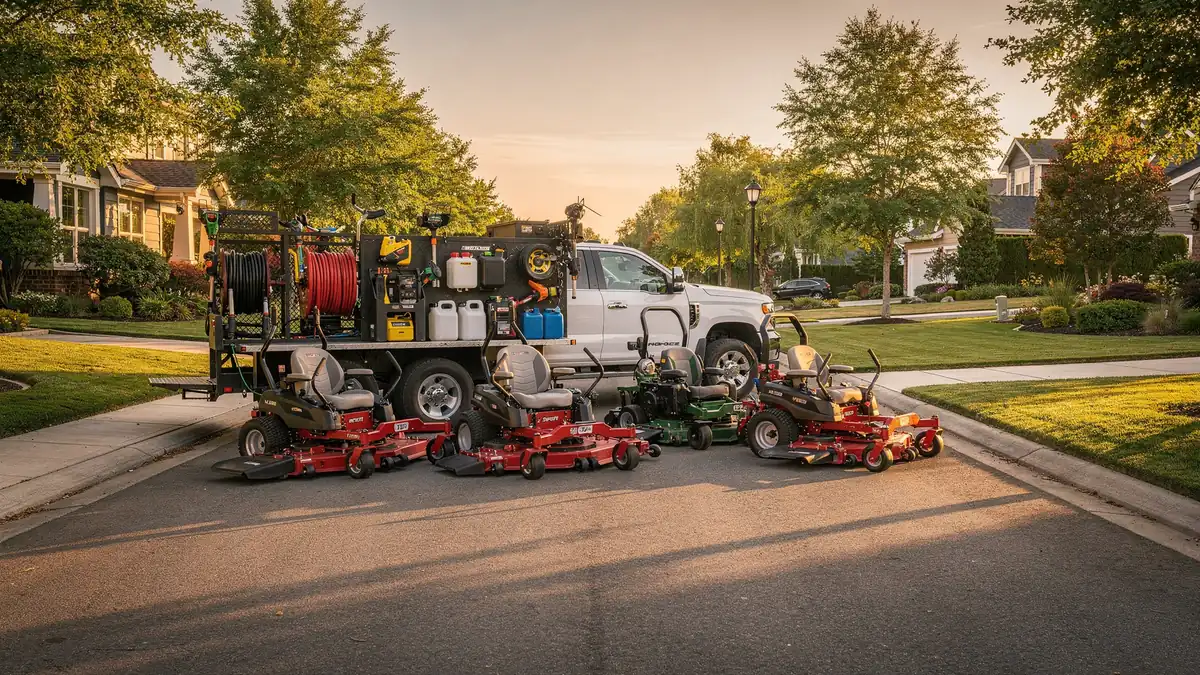
The minimum charge is your published smallest invoice — the number below which you decline the job. It is not an arbitrary round figure and it is not a negotiation opening; it is derived cost, rounded to something you can say out loud. Every stop, regardless of size, carries a fixed bundle: the drive to and from, loading and unloading the trailer, equipment setup and breakdown, the paperwork minute, and the wear the trip puts on truck and trailer. The minimum exists to make that bundle break even at worst. Typical floors run $30–$50 for mowing and $100–$150 for pressure washing, and service intensity explains the gap — a washer brings water sourcing, chemical, hose runs and surface pre-treatment that a mower trailer does not.
Two properties make a minimum work. First, it is published — customers hear it before they hear a price, so it reads as policy rather than insult. Second, it is enforced — one waived minimum becomes a story the neighborhood retells, and stories travel. The minimum also quietly improves your routing: when tiny stops stop being profitable, you stop scheduling them three towns over, and your route density improves as a byproduct.

How Minimum charge affects your numbers
Derive your own instead of borrowing mine. At a $70 hourly floor (about where the hourly rate calculator lands for a solo operator with commercial gear), the per-stop cost stack looks like this:
| Per-stop cost | Time / share | At $70/hr floor |
|---|---|---|
| Round-trip drive to a typical stop | 20 min | $23.33 |
| Load-out, unload, setup, paperwork | 10 min | $11.67 |
| Truck wear, fuel share, admin share | — | ~$5.00 |
| Cost before the first pass | 30 min total | ≈ $40.00 |
Read the bottom line honestly: at $70 an hour, the truck rolling down the street costs you about $40 per stop before a single blade of grass is cut. A $25 mowing minimum under that stack is a monthly donation plan. Published minimums by service, from the MowMath market data:
| Service | Typical U.S. minimum | Why |
|---|---|---|
| Mowing (per visit) | $30–$50 | Trailer roll plus 15–20 min on site |
| Pressure washing | $100–$150 | Water, chemical, hose and surface setup |
| Leaf cleanup / spring-fall cleanup | $150+ | Flat-quote work; small still fills a truck |
| Mulch installation | $150–$250 | Truck, loader and a morning regardless of yards |
| Aeration (typical job) | ~$75 | Most jobs price $75–$200; small lots hit the floor |
Season math on one waived minimum: a $20 mow against a $40 true cost loses $20 per visit, $600 over a 30-week season — on one friendly customer. Five such stops is $3,000, which is a commercial mower payment. The benchmark for whether your floor is serious: the Bureau of Labor Statistics median wage for grounds maintenance workers is $19.27 an hour as of May 2025 (per BLS occupational data) — an employee rate. Your minimum has to cover owner-scale fixed costs no employee wage carries, which is why $30–$50 is the floor, not the ceiling.
Common mistakes with minimum charges
Not having one. The default failure. Every price list needs a smallest number, or the market's smallest jobs find you first and the profitable ones queue behind them.
Setting it below per-stop cost. A $25 minimum with a $40 cost stack means your busiest hours are your least profitable. Derive it, publish it, re-derive it when fuel or insurance moves.
Waiving it for neighbors and relatives. Each waiver is a price test the customer retells. Upgrade scope instead — an add-on service like edging turns a $24 computed mow into a $39 real invoice without breaking the policy.
Apologizing for it. The minimum is professional policy, not a personal favor being denied. State it once, plainly, with the reason: the truck roll costs the same for any lawn.
When the minimum charge matters most
It matters most in dense markets full of small lots, where the size-based price computes below the cost of arrival, and on routes where small stops sit between big ones — the minimum is what makes those glue stops pay their way instead of padding the day. It matters most for one-off and seasonal services with heavy setup (washing, cleanups, mulch), and at the exact moment a customer asks "it's such a small yard, could you do it for twenty?" — which is the moment the policy earns its keep. Set the floor with the calculators — mowing, pressure washing, hourly rate — and see the MowMath home page for the full series.

FAQ
What is a minimum charge in lawn care?
The smallest price you will accept for any job — typically $30–$50 for mowing and $100–$150 for pressure washing. It covers the costs every stop carries before work begins: drive, load-out, unload, setup and the first minutes of work. It turns a tiny stop from charity into a real stop.
How do I calculate my minimum charge?
Add your per-stop fixed costs: round-trip drive time at your hourly floor, load and unload time, and a share of overhead. At a $70 floor: 20 minutes driving is $23.33, 10 minutes setup is $11.67, about $5 of truck and admin — roughly $40 before the blades spin. Your published minimum should sit at or above that.
Why is the mowing minimum lower than pressure washing?
Setup intensity. A mow arrives on a trailer that unloads in minutes; pressure washing carries water sourcing, hose runs, surface pre-treat and soap, so a small driveway still burns real setup minutes. Water, chemicals and machine wear push the washing minimum to $100–$150 against $30–$50 for mowing.
Should I ever waive the minimum charge?
Almost never, and never twice — every waiver teaches the customer the price was optional. If the stop is marginal, upgrade the scope with an add-on like edging to clear the minimum, or refer the tiny job out. A $20 mow that costs you $40 is a $20 loss that repeats weekly.
Does a minimum charge apply on top of per-visit pricing?
Underneath it: the per-visit price is whatever your size-based rate produces, and the minimum is the floor that answer cannot fall below. A 2,000-square-foot lawn might compute to $24, but it bills at the $35 minimum because the truck roll costs the same regardless of lawn size.
What does mowing without a minimum cost over a season?
If your true cost to roll the truck is about $40 and you bill $20, you lose $20 per visit — $600 over a 30-week season on one customer, and $3,000 across five small stops. The minimum is the single fastest margin fix in a service business.