Pressure Washing Prices in San Antonio (2026)
San Antonio pressure washing prices typically run below national benchmarks — the metro sits in the below-average cost band. A 600–1,000 sq ft driveway most often quotes $100–$225, a full house soft wash runs roughly $210–$525, and wood decks land near $125–$300. The market earns its character from three South Texas specifics: a winter cedar-pollen season that films every surface, aquifer water with heavy mineral content that streaks siding and glass wherever sprinklers spray, and a conservation culture run by SAWS that makes the whole city water-aware.
By the MowMath editorial team · Updated $1
Key numbers at a glance
| Job | Typical San Antonio range (2026) | Notes |
|---|---|---|
| Driveway (600–1,000 sq ft) | $100–$225 | Cedar film and hard-water streaks; cracked slabs need lower pressure |
| House wash (1,500–2,500 sq ft siding) | $210–$525 | Soft wash; pollen film and sprinkler streaks are common |
| Driveway + house bundle | $300–$650 | Best per-hour value; same stop, same setup |
| Wood deck (200–400 sq ft) | $125–$300 | Lower PSI; sun and heat check the wood |
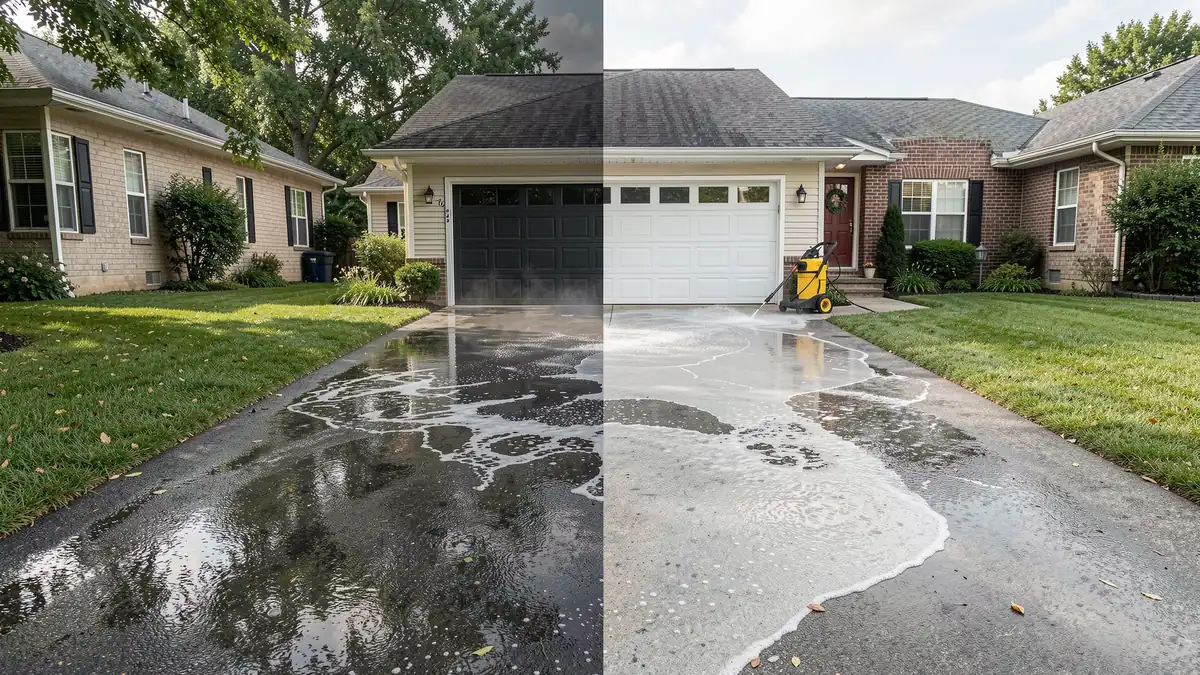
Pressure washing prices in San Antonio: the ranges
The national benchmarks this site uses are $120–$260 for a driveway, $250–$600 for a house wash and $150–$350 for a deck. San Antonio sits in the below-average cost band, so those figures shift down — typically by roughly 10–15 percent — and condition decides where inside each band a quote lands. A newer vinyl-sided home in Stone Oak with light dust washes fast; the same house after cedar season carries a pollen film that needs pretreatment, and lower siding streaked by mineral-heavy sprinkler spray wants chemistry, not just rinse. Every number below is a hedged range for planning, not a surveyed price.
| Job | Typical San Antonio range (2026) | Notes |
|---|---|---|
| Driveway (600–1,000 sq ft) | $100–$225 | Cedar film and hard-water streaks; cracked slabs need lower pressure |
| House wash (1,500–2,500 sq ft siding) | $210–$525 | Soft wash; pollen film and sprinkler streaks are common |
| Driveway + house bundle | $300–$650 | Best per-hour value; same stop, same setup |
| Wood deck (200–400 sq ft) | $125–$300 | Lower PSI; sun and heat check the wood |
| Patio / pavers + poly sand | $175–$400 | Back patios and covered porches are steady work |
| Fence (linear ft) | $1.25–$3.00 / ft | Both sides priced separately |
Inside the metro, the pattern runs by age and setting. The central loop — King William, Monte Vista, the near-northside historic districts — carries century-old brick, limestone accents and shaded lots that quote mid-to-high in the band because the materials demand care. The far north — Stone Oak, Alamo Ranch, the Highway 281 corridor — is dominated by newer brick and stucco with wide driveways that wash clean and fast. East and west mix military-neighborhood mid-century stock with new builds on the same bands. Access, shade and surface, more than geography, decide the number — and the metro's affordability keeps every band south of the national line.
What moves prices in San Antonio
Climate, cedar and mildew. San Antonio is humid subtropical but on the drier side, with long, hot summers. Winter brings the region's signature event: mountain cedar (ashe juniper) releases pollen roughly December into February, and the film it leaves on siding, glass, fences and driveways triggers a wave of wash calls once it settles. Humid stretches grow mildew and algae on shaded north walls and fence lines, though slower than in Houston or Florida. Summer heat bakes stains into concrete and pushes crews to dawn starts. Most homes here benefit from a wash roughly every one to two years, with post-cedar-season washes the most common trigger.
Hard water, housing age and clay soil. The suburban stock skews newer — brick, stucco and vinyl that soft wash quickly — while the historic core carries old brick and limestone that want low pressure and gentle chemistry. The distinctly San Antonio complication is water itself: the Edwards Aquifer supply is mineral-heavy, so sprinkler overspray leaves white calcium streaks on lower siding, glass and garage doors that plain rinsing does not remove — removing them is chemistry work and shows up in the quote. Underneath everything sits South Texas expansive clay: slabs shift, crack and offset, and blasting cracked joints widens fault lines and blows out joint sand, so careful crews drop PSI on damaged sections and quote sealing as a surface-preserving upsell.
Heat, seasonality and competition. Working hours compress in summer, so the practical season front-loads into spring and runs through a warm October. The busiest windows are the post-cedar flush in late winter and the spring pollen wave, when good crews book out. What keeps quotes down even in those windows is competition: the metro supports a dense field of small operators, and price-shopping is part of the local culture — which is exactly why the below-average band holds. Get three quotes and weigh what each includes; the cheapest ticket rarely bundles chemistry, sealing or drain protection.
Local cost drivers and water rules. Labor and operating costs run under national averages — that is the discount you see in every row of the table. On water: San Antonio is one of the most conservation-minded big cities in the country because its supply rises and falls with the Edwards Aquifer. SAWS runs staged conservation rules that mainly restrict irrigation days and hours, and a wash uses a small fraction of what irrigation does, but stages can tighten quickly in dry cycles — verify the current stage with SAWS before scheduling recurring work. As everywhere, wash water belongs out of storm drains; crews working curb-line driveways should carry drain protection, and the city's creek and river corridor layout makes that a real expectation here.
Questions worth asking any San Antonio provider:
- How do you remove hard-water streaks? Mineral spotting needs an acid-based treatment and rinse — not more pressure.
- What takes the cedar film off — water or chemistry? Pollen film needs a pretreat and rinse; water alone leaves the haze.
- How do you treat cracked slab concrete? Dropped pressure on cracked areas and a sealer conversation, not full blast across joints.
- Can you bundle driveway, house and fence? Bundles are the best per-hour value in every market, including this one.
Stack these bands against the other 24 metros on the pressure washing prices by city hub, turn any surface into a defensible number with the pressure washing calculator, and compare the other half of the property budget on the lawn care prices in San Antonio page. The local band sets the market; the math keeps you honest inside it.
FAQ
How much does pressure washing cost in San Antonio?
San Antonio sits in the below-average cost band, so expect roughly 10–15 percent under national benchmarks: typically $100–$225 for a 600–1,000 sq ft driveway, $210–$525 for a full house soft wash, and $125–$300 for a wood deck. Cedar-pollen film, hard-water mineral streaks and cracked clay-soil slabs move quotes toward the top of the band.
How much does it cost to pressure wash a driveway in San Antonio?
Typically $100–$225 for 600–1,000 sq ft of concrete. South Texas clay shifts slabs, so settling cracks and offset joints are common — careful crews drop pressure on cracked areas, and irrigation water with heavy mineral content leaves white streaking that needs a proper rinse.
How much does a house wash cost in San Antonio?
Roughly $210–$525 for 1,500–2,500 sq ft of siding, soft wash with chemicals included. Winter cedar pollen coats every elevation, and sprinkler spray leaves hard-water spots and streaks on lower siding.
Why is pressure washing cheaper in San Antonio than the national average?
San Antonio is a below-average cost-band metro: labor and operating costs run under national averages and competition is dense, which presses quotes down. Deep summer heat and aquifer-driven water awareness shape scheduling more than price.
Do San Antonio water restrictions affect pressure washing?
Rarely directly. SAWS runs staged conservation rules tied to Edwards Aquifer conditions that mainly restrict irrigation days and hours, and a wash uses a small fraction of that volume. Verify the current stage with SAWS before scheduling recurring work.